
Your appointment book could look just as full in 2027 while your Medicare collections come in lower. For an independent medical practice, that difference can show up in the dollars available to hire, invest in the practice, or fund an owner’s retirement. The Centers for Medicare & Medicaid Services published its 2027 Physician Fee Schedule final rule on November 9, 2026. Two changes deserve a close look before the January 1 effective date. Federal Register final rule
Two changes can affect the same encounter
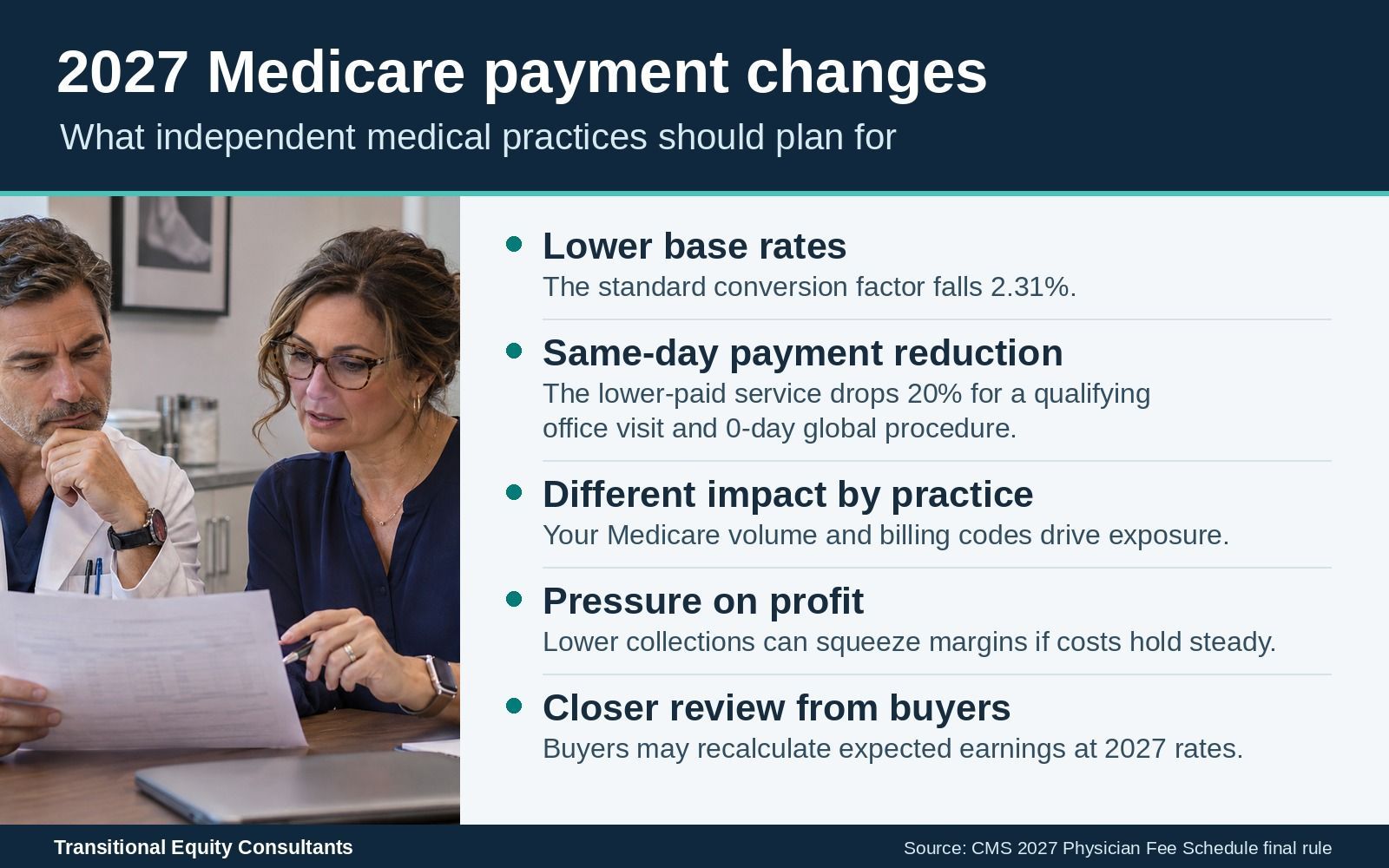
The base payment multiplier is lower. A temporary 2.5% increase for 2026 is expiring. CMS set the standard 2027 conversion factor at $32.63, down 2.31% from $33.40. For clinicians who qualify through an advanced alternative payment model, the factor falls 1.83%, from $33.57 to $32.95. Because the conversion factor is only one part of the fee calculation, the dollar impact also depends on the service code and geographic adjustments. CMS final-rule fact sheet
Some same-day services are paid at a reduced rate. The rule applies when a separately billable office or outpatient evaluation and management (E/M) visit with modifier 25 is paired with a 0-day global procedure and the services are furnished by the same clinician or clinicians of the same specialty in the same group. For qualifying encounters, Medicare pays the highest-valued service at its full scheduled rate and reduces the lower-valued service by 20%. The visit or the procedure can be the lower-valued service. CMS estimates podiatry, dermatology, and otolaryngology will be among the specialties most affected by this provision. Federal Register final rule
What a $20 difference can mean over a year
Suppose the 2027 fee schedule allows $150 for a procedure and $100 for the associated visit before the same-day adjustment. In a qualifying two-service encounter, the procedure stays at $150 and the visit drops to $80. That takes the combined allowed amount from $250 to $230, an 8% reduction in this example.
Repeat that encounter 1,000 times and the same-day adjustment lowers annual Medicare allowed charges by $20,000. To translate that figure into a budget, estimate what you actually collect, including applicable patient cost sharing, and account for any expenses that move with revenue. If collections fell by $20,000 and expenses stayed flat, operating profit would also fall by $20,000.
What to review before January
- Find the claims most exposed. Pull 12 months of traditional Medicare claims. Ask your billing team to identify modifier 25 visits paired with a same-day 0-day global procedure, confirm which encounters meet the rule, and review the documentation supporting separate billing.
- Reprice last year’s volume at next year’s rates. Use the local 2027 fee schedule for your most common codes and apply the same-day adjustment where it belongs. Review Medicare Advantage and commercial agreements individually for rates tied to Medicare. CMS 2027 fee schedule files
- Build the result into your operating forecast. Estimate monthly collections and profit at the same patient volume first. Then test how changes in volume or expenses would affect your margin. Compare the forecast with actual remittances once the new rates take effect.
What a buyer or partner will ask about
When a buyer reviews your trailing 12 months of earnings, they’ll want to know how much of that income will carry forward. If reimbursement is changing, show the dollar impact you can tie to specific codes and payers. Then show how that flows through to operating profit. A buyer can follow your assumptions and compare them with their own, and you can evaluate whether an offer reflects what your practice is likely to earn.
The same forecast helps if you intend to stay independent. It gives you a basis for staffing and growth decisions before the new payments start coming in.
Considering a sale, merger, or partnership?
Transitional Equity Consultants helps independent practice owners evaluate their options and prepare for buyer due diligence. For a confidential conversation about your goals, call Brad Stoller at 412-368-2235 or email brads@transitionalequity.net.
Podiatry owners can also take our complimentary Podiatry Practice Due Diligence Readiness Assessment.